
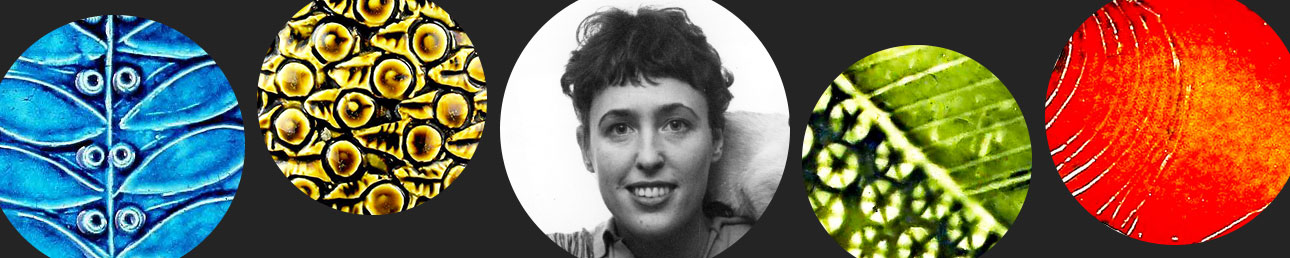
Lisa Larson – A Biography
Growing Up in the South of Sweden
Lisa Larson (born Alhage) was born in 1931 in Härlunda in the south of Sweden. Her father ran a sawmill and was a passionate art lover. He often returned from business trips with new works of art for the family home.
| "There was an abundance of art in my childhood home, and I grew up with dreams of becoming an artist." |

Childish drawing from a sketchbook in the 1970s

Lisa (left) and her sister, Titti Wrange, during their teen years
During her childhood, Lisa developed a great interest in creating with her hands. She designed clothes, painted the surroundings, and carved wooden figurines from materials from her father's sawmill. A summer guest during her late teens would unexpectedly affect her future.
| "A teacher at the College of Crafts and Design in Gothenburg got to see a drawing and encouraged me to apply. I submitted three wooden figurines, clearly inspired by Döderhultarn (Swedish artist), and was accepted." |
VIDEO: Lisa Larson about her childhood. (English subtitles available)
Art Studies in Gothenburg
During her adolescence, Lisa Larson had the ambition of becoming a fashion designer. (That was instead the fate of her sister, Titti Wrange.) But when Lisa started the ceramics program at the College of Crafts and Design in Gothenburg, she found her place in life.
| "It was a fantastic feeling to realize that clay was my material. But sometimes I can be a little jealous of textile designers because it is an easier craft, from a purely material point of view." |
After the lessons, she happily stayed in the workshop for free creation at the turntable. After a year in Gothenburg, Lisa met the love of her life at a Christmas bazaar. It was Gunnar Larson – a young man with a fondness for dressing in black from the city's art college, Valand.
| "But he danced with everyone else, and not with me. Before the last dance, he finally asked me and then followed me home to the door. I was as if struck by lightning with love! Six months later I moved into Gunnar's room. We were poor, but those were wonderful years." |

Lisa carving a vase during her art studies in Gothenburg

Vase for an art competition during her student years
At the end of the five-year education, Lisa participated in a Scandinavian art competition. Her contribution was a cinnamon-brown vase with a carved decor. One of the jury members was Stig Lindberg, the artistic leader of Gustavsberg's porcelain factory. He was impressed by her vase and later offered her a one-year trial at the factory. Lisa, however, had long dreamed of free artistic life in her own studio.
| "I was skeptical about working commercially, but because I could work on my own projects at the same time, I still said yes. Gunnar and I would stay 26 whole years in Gustavsberg." |
VIDEO: Lisa Larson about the offer from Gustavsberg. (English subtitles available)
A Golden Age for Swedish Design
Lisa Larson began her professional career at Gustavsberg during the glory days of Swedish design. Artists were employed in prosperous manufacturing industries which designed everything from furniture and textiles to plastic and stainless steel. The public's interest in good design was broad and strong.

Unique pigeon with a carved pattern from 1953

Lisa and the other apprentices, Eje Öberg and Gabrielle Citron-Tengborg, with mentor Stig Lindberg during the trial year at Gustavsberg
The Gustavsberg factory at Värmdö outside Stockholm was one of the leading ceramic manufacturers in the Nordic region. When Lisa and Gunnar arrived, there were already many prominent artists in place, such as Wilhelm Kåge, Berndt Friberg and Stig Lindberg. The young couple was housed in a simple room with kitchenette and shower access at a short distance.
The Playhouse and Stig Lindberg
Lisa Larson and the other young artists had great creative freedom during the year. They were placed in "the Playhouse" as the studio for the new talents was called. Stig Lindberg took on a mentor role for the group, and he often visited the studio to discuss their work.
| "Stig was dynamic and could stir strong emotions, but he always supported me, and we worked well together." |
VIDEO: Lisa Larson about Stig Lindberg. (English subtitles available)
Lisa's First Years as an Employed Designer
Lisa Larson's was hired after her year trial period. She quickly became one of the more prominent designers. Her figurines often represented people and animals with soft and swelling shapes. The expression was warm-hearted, humorous and subtly ironic.

Lisa with the cats from "Stina with cat", "Small zoo" and "Big zoo" in the late 1950s

Large parts of the series "Small Zoo" from 1956
One day in the middle of the 1950s, Lisa modeled a cat with the tail straight up in the air. The cat was made of dark brown stoneware with carved stripes. This modernist figurine was followed by two other cats in the same style, typical for the period. They later became part of the series "Small Zoo", her first successful series at Gustavsberg.
VIDEO: Lisa Larson about crafting figurines. (English subtitles available)
During the Gustavsberg years, Lisa discovered the possibilities of the stoneware material. This type of clay can be burned at a higher temperature so that it sinters (vitrifies). The result is a durable and waterproof ceramic material.

Lisa Larson's figurine "Gustaf" in chamotte stoneware clay

Lisa Larson's figurine "Oscar" in white stoneware
Lisa almost always mixes stoneware with chamotte, which is finely crushed burnt clay. The clay was developed at Gustavsberg's laboratory according to her wishes. The chamotte stoneware gives the objects the grainy and rustic look that characterizes Lisa's design.
VIDEO: A short film about Lisa Larson at Gustavsberg Porcelain factory. (English subtitles available)
Lisa Larson as a Portrayer of Women
Lisa has designed countless women in her serial production and unique art. The most famous are undoubtedly the ABC girls from 1958. The five figurines with curvy shapes all have names that begin with A to E. The variants with the floral chromo print are more unusual and highly sought after among collectors.
| "The reason they were so round was that they were supposed to be book supports, but they became too light for that purpose. I still liked the shape. Things often become a bit round when I work." |

The series "ABC girls" from 1958

ABC-girl "Charlotte" with chromo printed dress
In Lisa's ABC girls, inspiration from buxom antique fertility goddesses such as the famous Venus of Willendorf can be seen. The lush forms of the girls clearly contrasted with the thin beauty ideal of the 1950s. A few critics turned up their noses, but the series quickly became a success among the public at large.
VIDEO: Lisa Larson about the ABC Girls. (English subtitles available)
The Period with Art Ware 1956-1964
Lisa Larson is best known for her figurines, but she has also designed a lot of art ware such as vases and bowls. During the years 1956–1964, her serial production included a large amount of art ware. In the series Varieté, Advent, Granada, Tarragona, Thalia, and Karolin, vases, and bowls were accompanied by candlesticks, ashtrays and mirrors. The decors were often carved or in colors typical of the time period, and feature geometric patterns. Motifs were often drawn from the human and animal world with stylistic features.

A selection of Lisa's art ware from the period 1956–1964

Unique and partially glazed vase with carved decor from the 1960s
Lisa's unique production from the period also contained many vases and bowls. They were many times handmade by chamotte stoneware in traditional shapes. The uniqueness was often carved with glazed parts in muted colors. The larger vases with intricate designs are popular with today's collectors.
Lisa as a Portrayer of Characters and People
Lisa Larson's figurines are usually archetypes. On a few occasions, however, she has portrayed specific people and literary figures. For example, her pieces Johanna in the series "Larson's kids" (1961) and Astrid Lindgren's "Pippi Longstocking" (1967).
| "Pippi had long legs, fell down easily and broke in the furnaces. She, therefore, became unprofitable for the factory. But Astrid Lindgren liked her a lot." |

Lisa Larson's sleepy "Johanna" from the series "Larson's kids"

Astrid Lindgren looks at Lisa's variant of Pippi Longstocking
Lisa's most famous portrait is, however, the then Minister of Finance Gunnar Sträng in 1972. The figurine was suitably designed as a money box with a coin slot but without the opportunity to take the money out. "What Sträng receives, he retains," as the finance minister is claimed to have said. The money box became a big seller and is today a common item in second-hand markets.
VIDEO: Lisa Larson about the Gunnar Sträng money box. (English subtitles available)
Art for the Wall
During the 1960s and 1970s, ceramics adorned the walls of many Swedish homes. Between 1959 and 1977, Lisa Larson designed approximately 50 wall plates for serial production. The vast majority were made with relief, a rustic expression and motifs with animals or people. The decorators were often given great freedom, which made for a large variety of color schemes. During the period Lisa also designed wall plates for several organizations.

A selection of wall plates from 1959–1977

First serially-produced wall plate "Rider" from 1959
All These Cats and Lions
Lisa Larson is strongly associated with her large number of cats, both domestic cats, and wild lions. Over the years, Lisa designed six lions and almost thirty cats have been designed for Swedish serial production. The roundest of the figurines were created at the turntable.
| "I have always had cats; it was a natural part of life in the country where I grew up. The calming effect of the cats is obvious, especially when they come to lie down on your lap." |
VIDEO: Lisa Larson about cats and lions. (English subtitles available)
Charity Design
Lisa Larson has been involved in charity projects throughout her career. The most famous is the series "Children of the World" which she designed in 1974–1975. The eight child figurines were a commercial success and some of the proceeds were donated to UNICEF (UN's Children's Fund).

Lisa and UN goodwill ambassador Danny Kay with "Children of the World" figurines 1974

Otter in the series "Endangered animals" 1975–1981
Similar projects were also carried out with the World Wildlife Fund (WWF) for the series "Endangered Animals" (1975-1981) and "Provincial Animals" (1990-1992). In recent years, Lisa has, among other things, sold signed first copies for charity and designed products for the Heart-Lung Fund.
VIDEO: Lisa Larson about the Children of the world series. (English subtitles available)
The Freelance Period in 1980–1992
The 1970s meant tougher times for the Gustavsberg factory. Because of worsening working conditions, Lisa Larson left the company in 1980. For the next decade-plus, she would try her luck as a freelance designer.
| "It was a great feeling to be so much in demand, and now a very exciting time for me started. It was completely different from the time spent at Gustavsberg." |
During the period, Lisa worked for Swedish companies such as Duka, Höganäs, Royal Krona, Kooperativa Förbundet, Åhléns, Sandbergs and Jie Ceramics. She also worked for the German companies, Goebel and Rosenthal.

A selection of the series "Provincial Animals" from 1990–1992

The figurine "Maja" from the studio production of the 1980s
Lisa’s production in the 1980s contained figurines, candlesticks, vases, bowls, and tableware in all kinds of styles. The most famous was the tableware series "Jang" (1985) for Åhléns and the series "Provincial Animals" for Jie Ceramics (1990–1992). The latter series consisted of 14 animals with everything from proud lynxes to confused hares. Originally, 25 province animals were planned, but Jie Ceramic went through financial hardship and canceled production prematurely. In addition to the freelancing, Lisa ran the company "Lisa Larson-design AB" together with former co-workers Franco Nicolosi and Siv Solin. The company conducted small-scale stoneware production in a studio close to Lisa's home.
VIDEO: Lisa Larson about the tableware series Jang. (English subtitles available)
Not Just Ceramics
Lisa Larson also worked with materials other than ceramics in the 1970s and 1980s. In freelance assignments, she designed glass (Royal Krona and Skruf), bronze (Galleri Scandia) and wood (Sandbergs). The artworks in bronze were made in limited editions and are popular with today's collectors
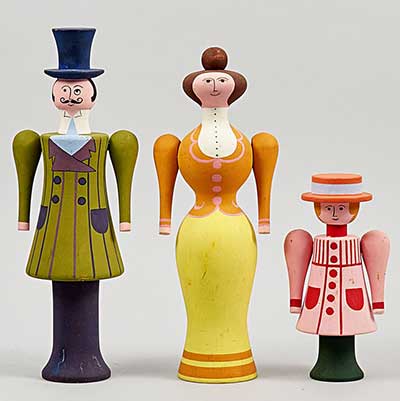
Wooden figures (1980s) from Sandberg
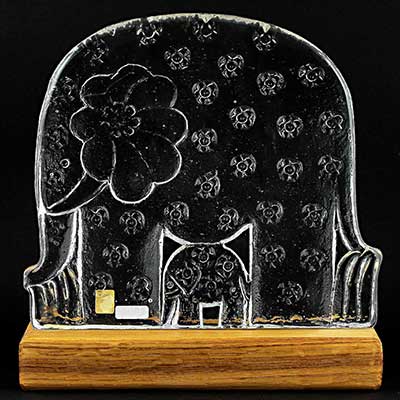
Glass Elephant (1970s) from Royal Krona
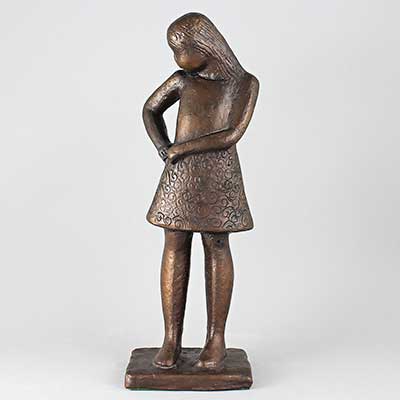
Bronze figurine "Teenager" (1970s) from Galleri Scandia
Unique Art
Throughout her career, Lisa Larson has mixed design for companies with free artistic creation. Her unique production comprises more than 60 years of artistry and consists mainly of vases and figurines. The unique objects are often inspired by primitive art and give a rustic impression. In her work, spontaneous fancies are valued higher than perfectionism.
| "The work on unique ceramics has always been a breath of fresh air. A creation where I do not have to take into account the working conditions of the serial production." |

Lisa with unique cats in the 1970s

Unique mother sculpture from the late 1950s
Lisa Founds the Ceramic Studio
In 1992, Lisa Larson, Franco Nicolosi, and Siv Solin founded the Ceramic Studio in Gustavsberg. The collaboration would mean a new age of glory for her artistry. Even today, she is still active in designing new objects. At the same time, the studio continues the tradition of more than 200 years of handmade ceramic production in Gustavsberg.

Lisa with the Ceramics Studio owners and employees in the early 2000s

Viking figurines from the 1990s
How Lisa's Objects Are Manufactured Today
At the Ceramic Studio, Lisa Larson's objects are still manufactured by hand. She first creates a model based on her sketches. The owner – Anders Engstrand – together with approximately ten employees then carry out the many steps to the finished figurine:
- Based on Lisa's model, an original model is created in several parts.
- The original model is used to manufacture molds.
- The clay is prepared with a high proportion of quartz and chamotte, and then poured into the molds.
- After the clay has solidified, the molds are opened, and the figurines are polished.
- The figurine is decorated by hand with glaze and paint.
- The figurine is then burned in an oven at 1240 degrees C.
- Some figurines are decorated again and burned at 800 degrees C.
- A small work of art is completed!
VIDEO: The production at the Ceramic Studio. (English subtitles available)
Lisa Larson ❤️ Japan
Lisa Larson encountered Japanese art as early as the 1950s when she visited the design exhibition H55 in Helsingborg and the Ethnographic’s and Röhsska Museum's collections of Japanese ceramics. During the 1970s and 1980s, she visited Japan several times, including for her own exhibition of unique stoneware in Tokyo.
In the early 2000s, a design shop owner in Osaka received a large Lisa Larson lion as a gift. She was delighted and contacted the Ceramic Studio and they began working together. Soon the first box of Lisa Larson figurines arrived in Japan and they sold exceedingly well.
Today, more than half of the Ceramic Studio's output goes to Japan. In 2014–2015, a Lisa Larson retrospective exhibition was conducted that toured eight Japanese cities. It attracted more than 200,000 visitors. Several licensing deals are in progress with Japanese companies that manufacture everything from ceramics to clothing and household items.
| "It's a lot of fun to be so acknowledged in my old age." |

Japanese poster for an exhibition 2014

Lisa Larson's cat Mikey which is reaping great success in Japan
An Artist to the End
Lisa and Gunnar lived their last years in Nacka, not far from the Ceramic Studio in Gustavsberg. The apartment was full of pictures, sculptures, sketches, models, brushes, unfinished projects, and new ideas. Lisa started every morning with quiet meditation, but the rest of the day was at full speed working with the clay. She passed away in 2024 at the age of 92, only a few weeks after visiting an exhibition of her unique pottery. An artist to the end!
| "There is so much I want to do. I don't have time to grow old!" |

Unique yoga figurine

Lisa and Gunnar enjoying each other's company
References
Books:"Lisa Larson – Bland lejon och änglar" av Gisela Eronn (2005)
"Lisa Larson – Keramiker" av Märta Holkers (2014)
