
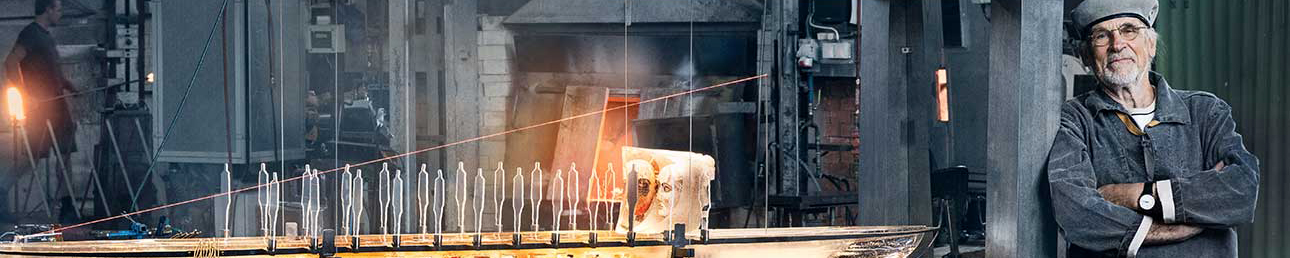
Bertil Vallien – Glass Boats
| "The boat is a symbol of our collective consciousness. She is a life-giving mother to trust when society is separated from the solid earth." |

Bertil Vallien's Boats - An Overview
The First Boats
During a trip to the Aran Islands off the west coast of Ireland, Bertil Vallien was captivated by the fantastic boats used by the island’s people. After his journey, he began to develop the idea of the boat as a container of an isolated world. The first time that Bertil publicly exhibited boats was at the "Farkoster" Exhibition in 1979 at Konsthantverkarna in Stockholm. The ships were made of red-brown clay and decorated with simple materials, such as twigs and stones. The exhibition created a natural, pristine and haunting impression. Some wondered whether Bertil’s boats were on the way to the kingdom of the dead.
| "I make boats because their shape is beautiful. It contains both mystery and symbolism. The boat is traveling, and life is sailing, from the beginning to the end." |

Bertil Vallien's work table with ceramic boat

Pottery boat from the "Farkoster" Exhibition
Success for Casted Glass Boats
It wasn’t until the middle of the 1980s that Bertil Vallien created the first sand-casted glass boats. His first exhibitions of these ships created great international interest. They were first exhibited at the prestigious Heller Gallery in New York and Australia. Soon after, the boats were presented in prestigious art magazines such as the "Corning Museum's New Glass Review."
| "The boat has always fascinated me, for its beautiful shape and for what it means: livelihood, adventure, travel, birth, and death. We all have a respectful relationship with the boat. The fisherman in the archipelago does not cut up his tired boat for firewood. When she can’t float any longer, she rests in peace and slowly nourishes new boats." |
VIDEO: Bertil Vallien about boat exibition in the USA. (English subtitles available)
How to Sand-Cast Boats
Bertil Vallien developed the method with glass casting in sand molds as early as the 1970s. But it was with the sand-casted boats in the 1980s that the technology first reached maturity. Ever since this period, Bertil has been fascinated by the artistic potential of sand-casted boats.
| "The vitrified life that is put into the boat is visible but inaccessible. What is laid down in the liquid glass mass can never be recovered, even if you break the sculpture." |
A successful sand-casting of a boat consists of several steps:
1. Bertil first creates all objects that will end up in the glass mass. Common objects are metal figures, colored glass heads, stones, geometric shapes, and rings. The handmade objects will have symbolic functions in the final artwork.
2. The red molding sand is prepared to a suitable moisture level and placed in a long metal box. Bertil then uses a wooden model to create the shape that determines the size of the sculpture. At the actual casting, the sand adheres to the glass surface and gives it a red tone. Other colors on the exterior of the glass sculpture can be obtained by dusting the mold with different oxides. Bertil creates irregularities in the exterior of the sculpture through imprints of stamps and other things in the sand mold’s surfaces. Some of the prepared objects are now placed inside the mold. It is then carefully moved from the cold molding room to the roaring fire in the foundry.

Hand manufacturing of objects that will end up in the glass mass

Bertil Vallien with sand-casting mold and symbolic objects
3. The melted full crystal glass in the crucible has a temperature of 1200 degrees Celsius. Large metal scoops are filled with the inert mass which is then emptied into the sand mold. All are taken aback for a moment by the heat. For a short time, the prepared objects will be meticulously placed in the fiery glass mass. New scoops of glass mass are pored over, and the heat is further increased.
4. The glass mass in the sand mold slowly starts to cool. Dazzling reddish colors first turn to red tones. The objects slowly appear in the glass. The hot and heavy mold is inserted deep into the cooling oven to slowly cool for several days. There the boat keeps its secret about its wellbeing for a few days. It is not until then that the massive glass mass has cooled slowly enough for tensions in the glass to be eliminated, and the risk of cracks is minimized.

Glowing glass mass in the sand mold

The work team inserts the mold into the cooling oven
VIDEO: Bertil Vallien about sand-casting. (English subtitles available)
Challenges of Sand-Casting
It is technically difficult to sand-cast as large glass sculptures as Bertil does. The largest boats are almost four meters long, and larger sculptures have not been cast anywhere in the world using this method. The problems often consist of the tensions that arise during large temperature differences between the surface and the core. What lies behind his ability to cast large sculptures is a variety of factors: the composition of the glass mass; the moisture and structure of the sand; the motion diagram of the casting; and the possibilities of cooling the large glass pieces according to a schedule. Be assured that there are many hours of hard work behind this success.
| "There were experiments, failures, and lessons learned from mistakes. Glass shrinks, sweats, cracks, and can explode. Snowfall and thunderstorms can make the oven stop. Anything can and does happen. I had a lot of experts who, despite their knowledge, scratched their head just like me. Why did a boat crack after six weeks in the cooling oven, and how slowly do you really need to cool the glass?" |

Sketch drawing of a boat from 1989

Bertil Vallien during the sand-casting of a larger boat
Symbolic Boats
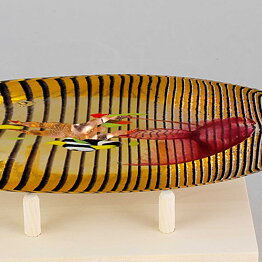
Bertil Vallien's boats describe the journey from yesterday to tomorrow. They form an encapsulated timeline where the stern is the past, and the bow is what is to come. The boats are loaded with a passenger and its attributes of the past. Significant symbols such as rings, chains, rods, stairs, buttons, and wheels fill the stern and center. The bow is always clear, as the future is unwritten and hopeful. The luster of the crystal glass - colored on the surface by oxides - form a container for the solidified scene.
| "I make boats sinking through memories and dreams. I make boats that don't need latitudes. They navigate as vitrified vessels to the horizons of fantasy. One container for Moses, and one for the Viking chief. The traveler must rely on the thin skin that is the only thing separating her from the unknown." |

Bertil Vallien in the river outside the home

Cross boat from 1987 with interior symbols such as mummy, ladder, and wire
One Million Dollar Boat
Bertil has created many eye-catching boats over the decades, but none has received as much acclaim as the boat "Passage." The three-meter-long ship is the most expensive glass sculpture ever produced at Kosta Boda and thus got the nickname "One-million-dollar boat." The boat depicts the mythology of world history, from birth to death. It floats over a forged landscape with glass details. A stand with protective glazing encloses the artwork. Mirrors at both ends of the stand create an endless optical illusion. The artwork was exhibited in 2016 on "Sculpture Objects Functional Art and Design," one of the world's largest art fairs in Chicago.
| "On life-threatening fluid, she flows – a world for herself. No one on solid ground hears or sees. The canoe's captain is king, dictator, and judge of the mystery, life and, danger of the events. Life is from the beginning sailed towards unknown goals." |
VIDEO: Bertil Vallien about the One Million Dollar Boat. (English subtitles available)
A Selection of Bertil Vallien's Boats
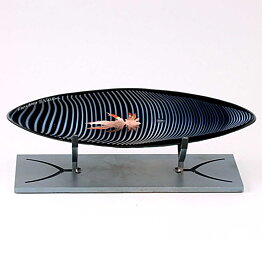
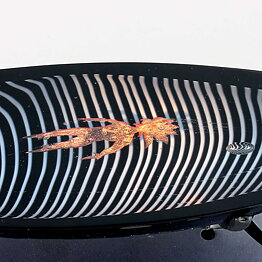
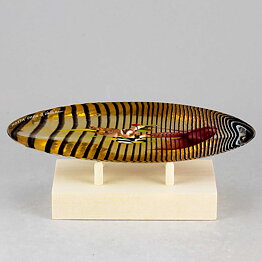
Bertil Vallien has sand-casted thousands of glass boats with different shapes, color schemes, and artistic content. His ships are represented at the most well-known art museums in the world such as the Metropolitan Museum in New York and Victoria & Albert in London. Here comes a selection of Bertil's boats!

"Voyage of Dreams", 1986

"Journey V", 1998

”Land skall med lag byggas”, 2014 (Svea Court of Appeal)

"Sea of future", 1986

"Spiral", 1983

"Auarry", 1984

"The secret of the Barn"

"Blue-voyage", 1990

"Cargo seed II"

Unknown name (Swedish National Museum of Art and Design)
REFERENCES
Video:
The video clips come from Peter Kruse's documentary "Glasmästaren" which was shown on SVT 2015. It can be seen in its entirety here.
Visit the page with all our objects by Bertil Vallien.