Gustavsberg


Gustavsberg – Pottery of Sweden
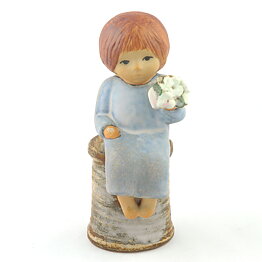
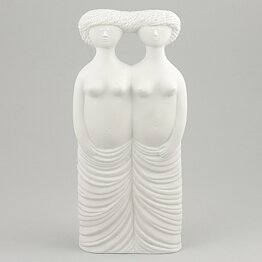
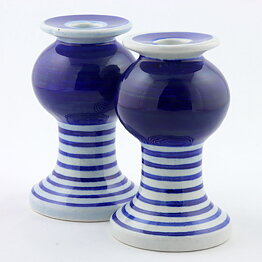
Gustavsberg was a flagship of Swedish ceramics from the start in 1826. Over the years, the company and its designers presented numerous art pottery and tableware classics. Which Gustavsberg design is your favorite?


A Short History of Gustavsberg
– Sweden’s Acclaimed Ceramic Factory


The Roots of Pottery Production in Gustavsberg

The Gustavsberg pottery and porcelain production in the southeast of Stockholm has a long and varied history. The nobleman Gustaf Gabrielsson Oxenstierna founded a brick mill in the area as early as the 1640s. After the death of Gustaf, his wife Maria Sophia de la Gardie named the brick mill area after him. The 21-year-old widow with two children never remarried and would become the leading business woman of the Swedish 17th century.

Painting of Maria Sophia de la Gardie

Painting of Maria Sophia de la Gardie

Tyresö castle, the home of Gustaf Gabrielsson Oxenstierna and Maria Sophia de la Gardie

Tyresö castle, the home of Gustaf Gabrielsson Oxenstierna and Maria Sophia de la Gardie

De la Gardie tried to recruit ceramic masters from Holland to build a porcelain factory in Gustavsberg. But her plan was never realized because none of the Dutch porcelain masters wanted to move to cold Sweden. The Gustavsberg pottery production had to wait a while longer.


Starting the Porcelain Factory

In 1826, the wholesaler Herman Öhman tore down the old brick mill and started a porcelain factory on the site. His plan was to supply the growing Swedish middle class with porcelain goods. However, there were major production problems in the factory, and the quality of the produced goods was substandard. No artists were recruited, and the Gustavsberg pottery was highly influenced by German and English shapes and decorations.

Gustavsberg pottery series “Ecclesial” from the 1840s
Gustavsberg pottery series “Ecclesial” from the 1840s

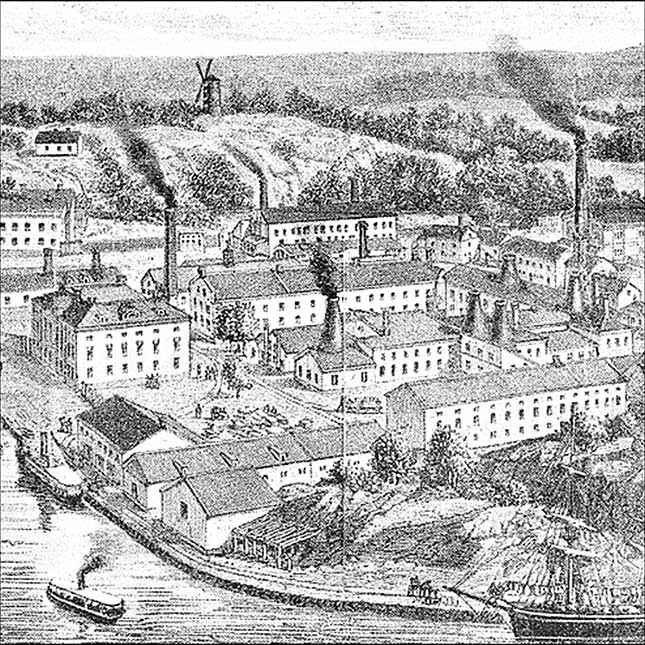
Drawing of Gustavsberg porcelain factory in the 1870s
Drawing of Gustavsberg porcelain factory in the 1870s

In the mid-19th century, Samuel Godenius and his son-in-law Wilhelm Odelberg took over the Gustavsberg pottery production. The new leadership gave way to industrial investments and a modernization of the work process. At the end of the century, the factory had become a large producer of bathroom porcelain and pottery art ware. Most noteworthy from the artistic production were the Parian and Majolica objects.

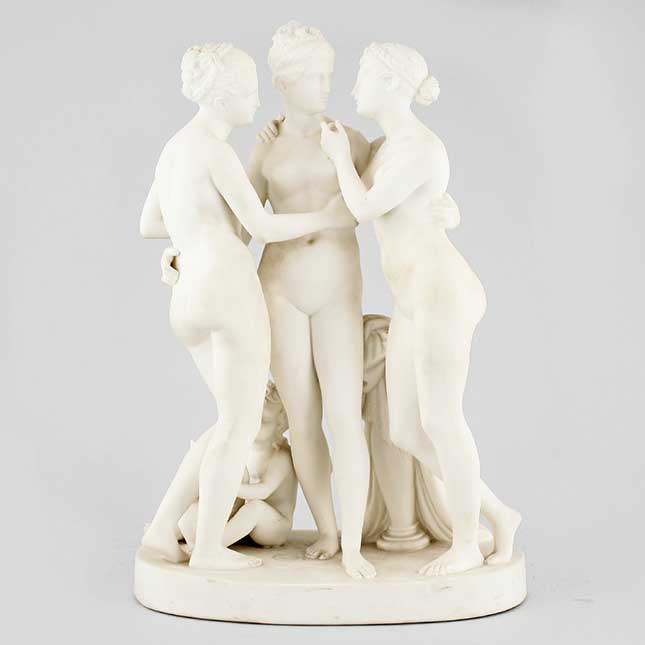
Parian figurine “The three Graces” from the mid 19th century

Parian figurine “The three Graces” from the mid-19th century


Majolica flower-stand from the late 19th century

Josef Ekberg – The Era of Inventive Glazes

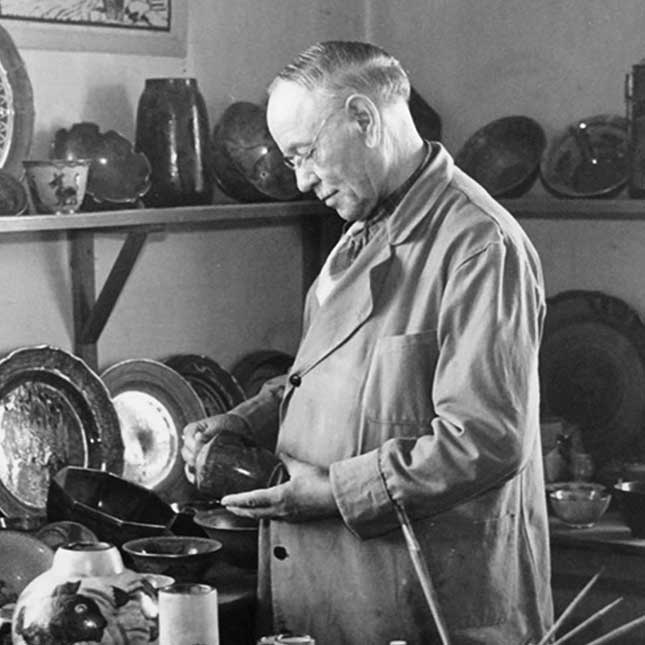
Like many of the local Gustavsberg boys, Josef Ekberg (1877-1945) started to work at the porcelain factory at the age of 12. He was first hired as an assistant, but over time he began crafting artworks on his own. Ekberg and fellow artist Gunnar Wennerberg jointly developed the famed Sgraffito technique, where a pattern is carved on a glazed surface. The art pieces they produced received a warm welcome at the World Exhibition in Paris in 1900. The Gustavsberg company was about to received worldwide recognition for the quality of its work.

Josef Ekberg sgrafitto vase from 1918

Gustavsberg sgrafitto vase from 1918

Josef Ekberg in the Gustavsberg factory
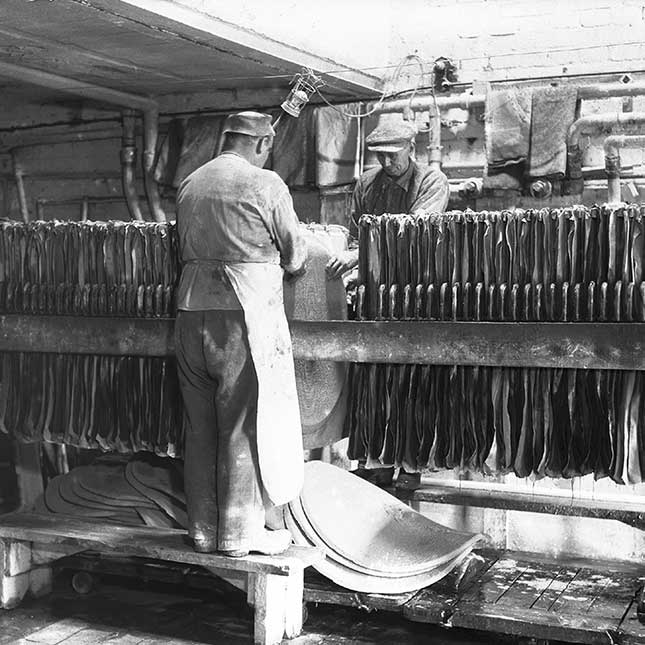
Josef Ekberg in the Gustavsberg factory

Ekberg was part of the “Swedish Grace” era in the first decades of the 20th century. This Swedish take on Art Deco was characterized by unadorned design with bold colors and strong contrast. His luster glaze pieces are beautiful examples of the era, with their geometric shapes, matte blue-green glaze and gold details.

Workers at the Gustavsberg factory in the early 20th century

Workers at the Gustavsberg factory in the early 20th century

Josef Ekberg 1930s urn with luster glaze

Josef Ekberg's 1930s urn with luster glaze

Wilhelm Kåge – Gustavsberg and the Modern Society

Wilhelm Kåge (1889-1960) first gained notoriety in Sweden for his colorful posters during the 1910s. He soon attracted the attention of the Gustavsberg factory which sought out artists with new ideas. Kåge accepted the offer from the factory, despite his lack of experience in ceramic production. His task was to add an artistic touch to the factory’s functional items.

The tableware series “Formosa” from 1921

The tableware series “Formosa” from 1921


The Gustavsberg factory in the background in 1938
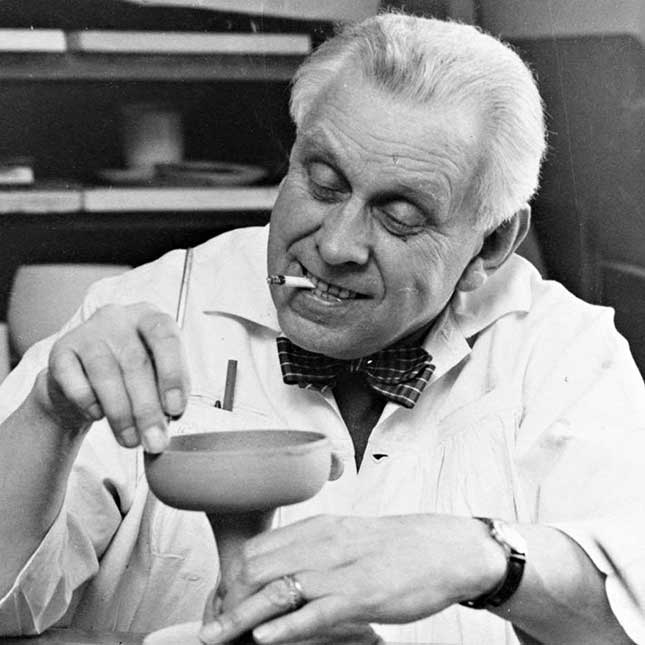
Within a year, Kåge had created the functional tableware series, “Liljeblå” (Lily Blue). The series became a success at the Liljevalchs Exhibition in Stockholm in 1917, which is noted as the birthplace of the modern Swedish art industry. It was the first time that artists and industries came together to create beautiful yet practical home decor. After the exhibition, Kåge was appointed artistic leader for Gustavsberg. Under his leadership, the Gustavsberg tableware series followed functionalist ideas regarding rational production and multi-functional parts.

Wilhelm Kage working on a Farsta piece

Wilhelm Kåge working on a Farsta piece

Footed Farsta bowl from the 1940s
Footed Farsta bowl from the 1940s

Kåge then presented the Farsta set – his most exclusive ceramic work – at the Stockholm Exhibition of 1930. The set comprises vases and urns, sculptures, ashtrays, and half-meter high pieces, all with a discernible presence and aura of quality. The pieces are marked with “Farsta” and are regarded as nobility in the world of Swedish pottery.

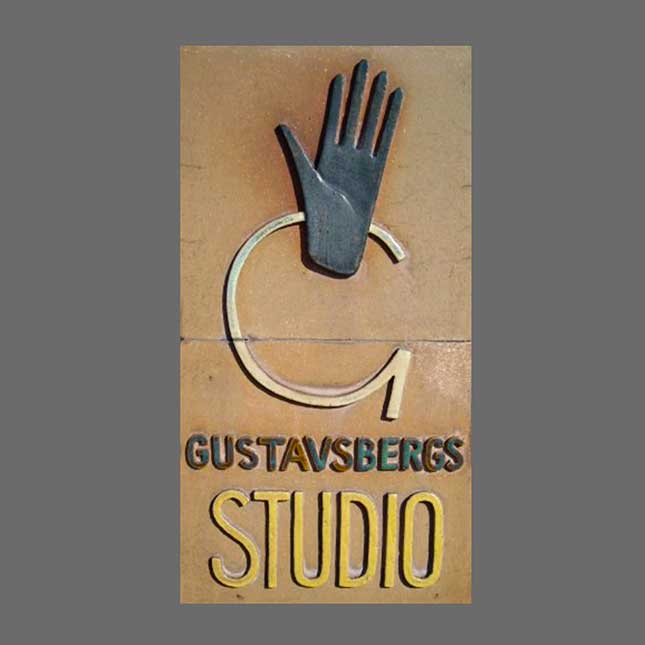
Signpost of the the Gustavsberg studio with the legendary hand

Signpost of the Gustavsberg studio with the legendary hand symbol

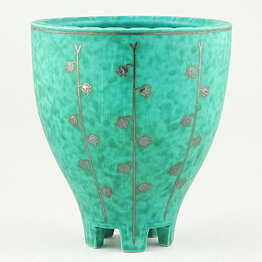
Wilhelm Kåge’s Argenta vase from the 1940s

Wilhelm Kåge’s Argenta vase from the 1940s

Wilhelm Kåge initiated the Gustavsberg studio in 1942, which would become the creative hub of the ceramic factory. The high-quality artworks were marked with the Gustavsberg studio hand in different colors. Kåge mainly added the studio hand in brown. Other artists used blue, black, yellow and red colors.

Berndt Friberg – Master Thrower

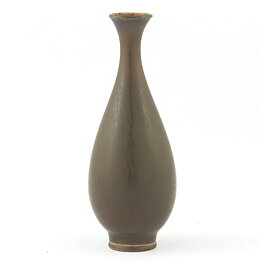
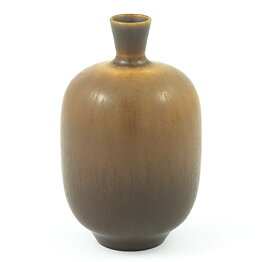
Berndt Friberg (1899-1981) was hired by the Gustavsberg factory in 1934. During his first years, he worked as a thrower for Wilhelm Kåge. Friberg’s arrival was marked by a significant increase in the quality of Kåge’s art pieces. Soon enough, he became the undisputed master thrower at Gustavsberg. Through his early career, Friberg wasn’t known for his artistic ambition. His artistic debut wouldn’t come until the age of 42. He became known as a perfectionist with an eye for delicate, sensuous forms and magnificent glazes.

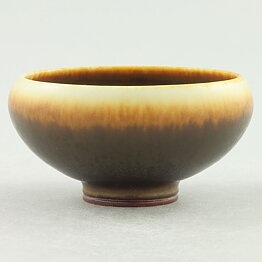
Berndt Friberg vase with swelling body and haresfur glaze from 1966

Berndt Friberg's vase with swelling body and haresfur glaze from 1966

Berndt Friberg working the throwing whee

Berndt Friberg working the throwing wheel

Friberg’s artworks ranged in size from no higher than a few centimeters to large floor vases. The contours were reminiscent of classic styles, including Chinese stoneware from the Song Dynasty. He continually refined his many glazes, recording the details in his famous “black book.”

Stig Lindberg – Gustavsberg’s Eccentric Genius

The young art student Stig Lindberg (1916-1982) went unannounced to the Gustavsberg factory in 1937 looking for a summer job. The skinny, odd-looking young man exuded confidence: ”If you hire me, I will ensure that there will be jobs in the factory.” Lindberg was hired as an assistant but climbed fast through the ranks because of his frenetic energy and wealth of fresh ideas.

Stig Lindberg decorating faience objects in the 1940s

Stig Lindberg decorating faience objects in the 1940s


Floral faience vase from the 1940s
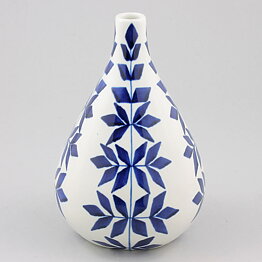
Wilhelm Kåge and Stig Lindberg jointly developed the noteworthy faience production through the late 1930s and early 1940s. The faience objects were created from reddish earthenware, coated with a milky-white glaze and hand painted bold colored decor. The floral motifs of the 1940s slowly gave way to the era-typical geometrical decor of the 1950s and 1960s. The faience series became a huge success and is still one of the most well-known symbols of Swedish mid-century design.

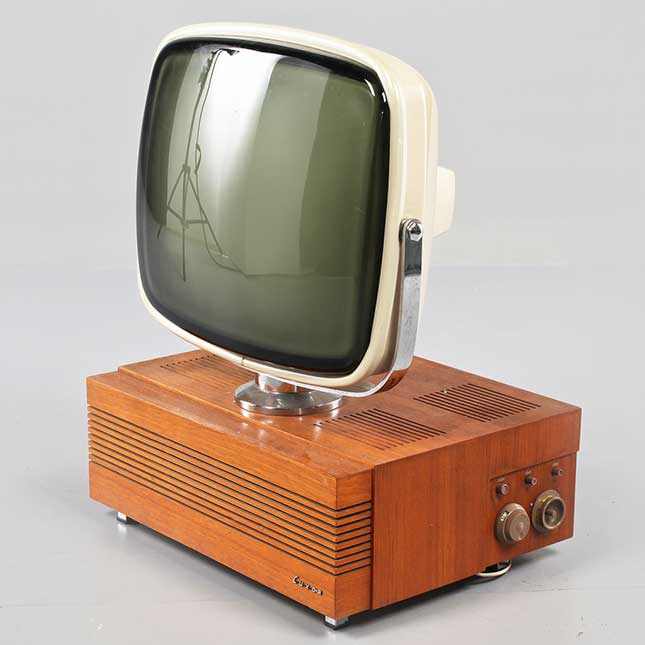
Luma TV designed by Stig Lindberg

Luma TV designed by Stig Lindberg

Stig Lindberg working as artistic leader. Probably early 1950s

Stig Lindberg working as artistic leader. Probably early 1950s

In 1949, Stig Lindberg succeeded Wilhelm Kåge as artistic leader. His influence was quickly felt across the entirety of the design world; from slender, delicate stoneware to TV sets, wash basins, tableware, home decor, textiles, children’s books, enamel, and glass art. It is easy to get lost in the sheer breadth of artistic production over Lindberg’s lifetime. He did not make a distinction between the artistic merit of industrial design and more traditional works of art. Lindberg famously noted, “A thumbtack holds for me as much poetry as a wildflower.”


Lisa Larson – Kind and Warm-Hearted Pottery
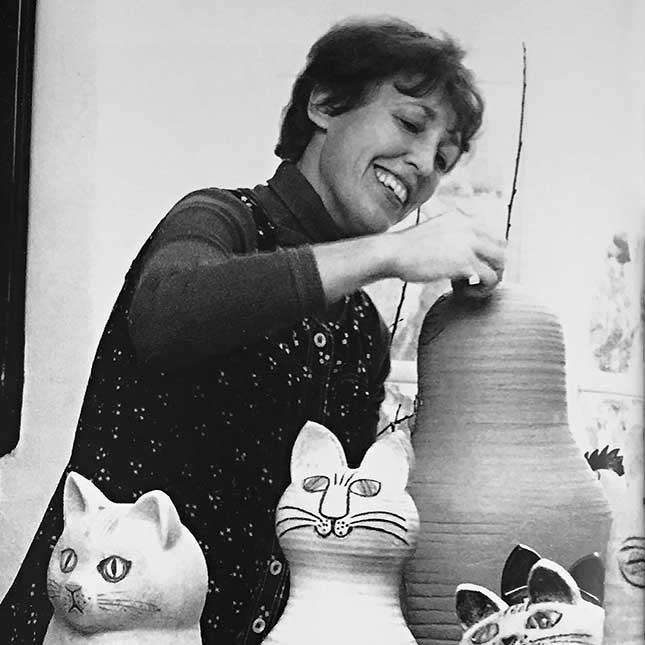
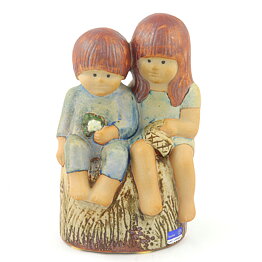
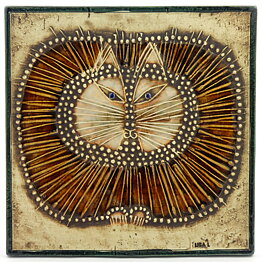
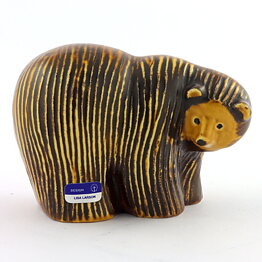
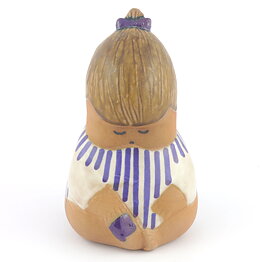
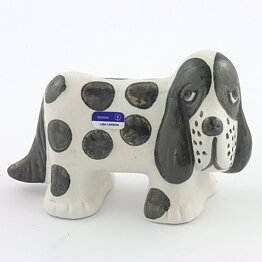
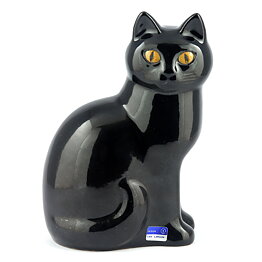
Lisa Larson (1931-) was hired by Stig Lindberg in 1954 after performing well in a Scandinavian school competition. The Gustavsberg factory flourished in the 1950s and 60s, and Larson quickly became one of the most notable designers. Her serial production often depicted people and animals with rounded and swelling shapes. The expression was warm-hearted, humorous, and sometimes subtly ironic.

Lisa Larson working on large unique cats

Lisa Larson working on large unique cats

Curvaceous ABC-girl Emma with chromo print
Curvaceous ABC-girl Emma with chromo print

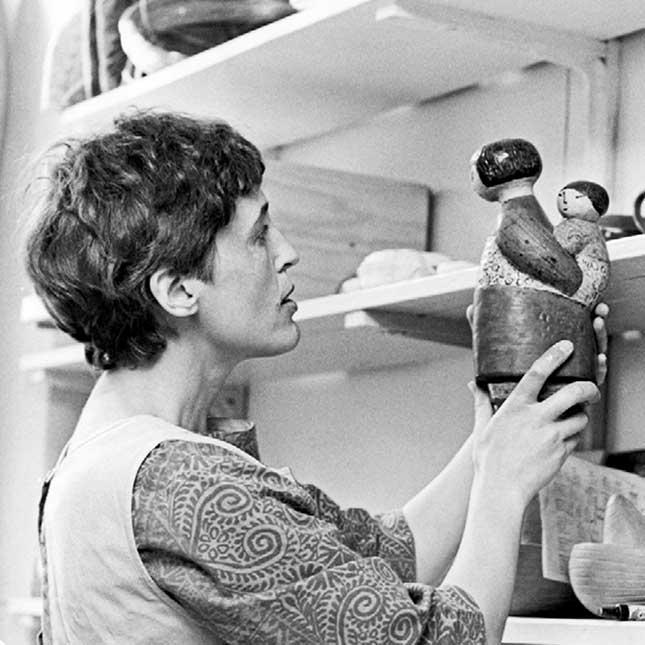
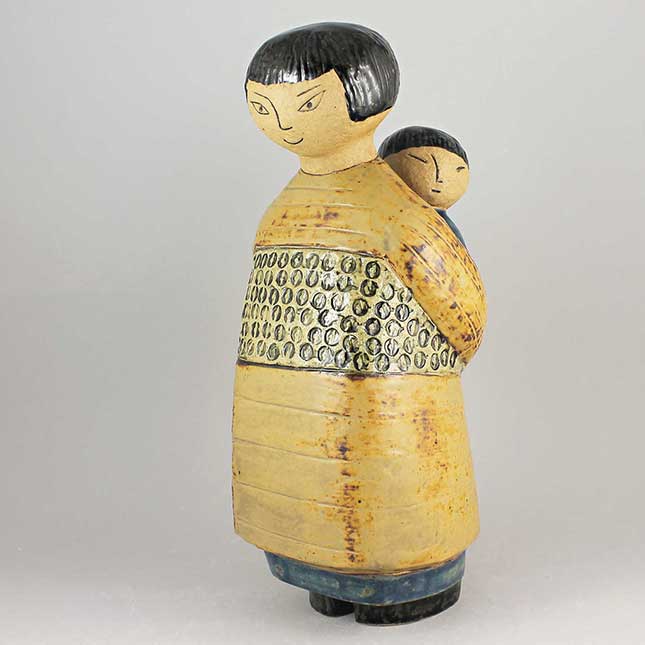
Rustic primitive art often inspires Larson’s unique artworks. Spontaneous whim is generally treasured more than perfectionism. She frequently experiments with traditional techniques, incised decorations, rough surfaces and matte glazes in her unique production.

Japanese woman figurine from 1958

Japanese woman figurine from 1958

Lisa Larson inspecting the Japanese woman figurine

Lisa Larson inspecting the Japanese woman figurine

Lisa Larson always mixes the stoneware clay with chamotte, a finely crushed oven-proof ceramic. The chamotte stoneware gives the art work the large grained rustic look which is the characteristic of her pottery.

Tougher Times for the Gustavsberg Porcelain Factory

The 1970s and 1980s became more difficult times for Gustavsberg. The factory found it harder to compete with pottery production from low-income countries. In 1987, the factory was sold to foreign interests, and soon after that production ended in Gustavsberg.

But soon enough, hand-made pottery was once again crafted in the area. Lisa Larson and her former fellow workers started Ceramic Studio Gustavsberg (Keramikstudion Gustavsberg) in 1991, and the cooperation revitalized her artistry. In 1996, the Gustavsberg factory was restarted as a worker cooperative, with small-scale production of some of Stig Lindberg’s tableware series. The Ceramic Studio and Gustavsberg factory carry forward the more than 200-year-long tradition of hand-made pottery production in Gustavsberg.

Gustavsberg’s harbor today

Gustavsberg’s harbor today

Lisa Larson outside her home
Lisa Larson outside her home

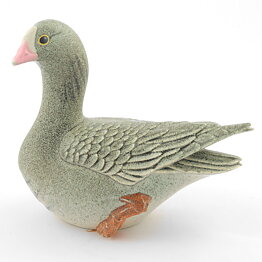
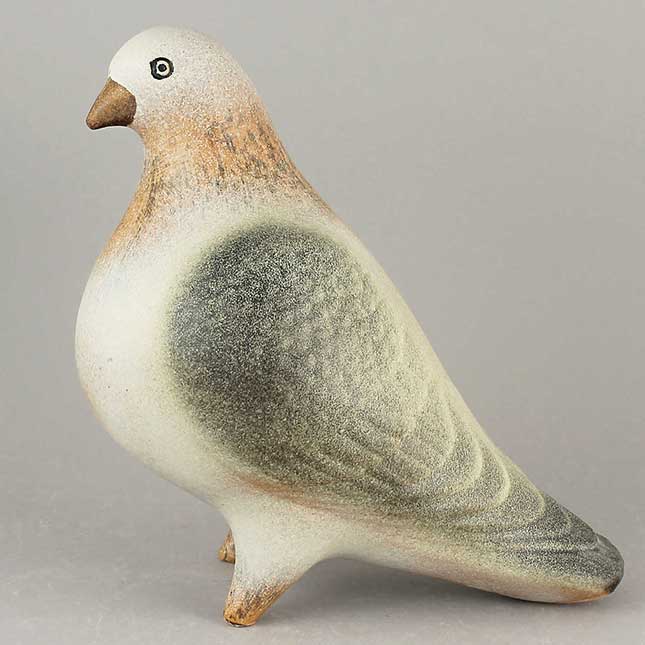
Lisa Larson’s dove from the 1990s.

Lisa Larson’s dove from the 1990s.