
Stig Lindberg – Unique Objects
Stig Lindberg’s unique production covers more than 40 years of artistry at Gustavsberg. The vases, bowls, and figurines were almost exclusively made of stoneware and incised with ”Stig L”. Find your favorites among his unique pieces or learn more about them in our overview.

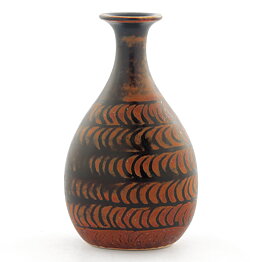
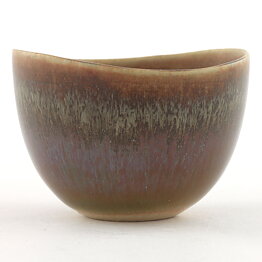
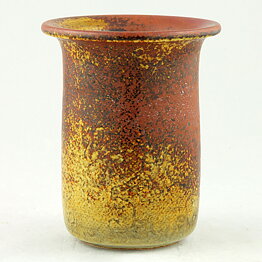
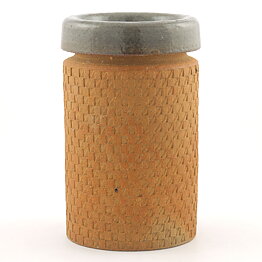
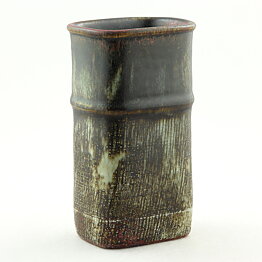
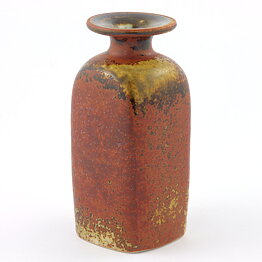
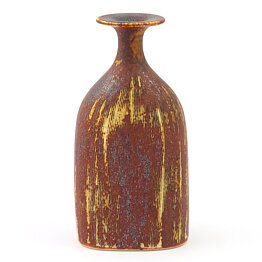
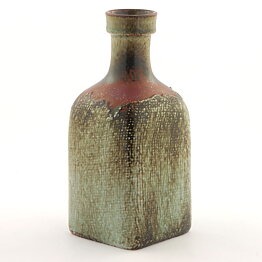
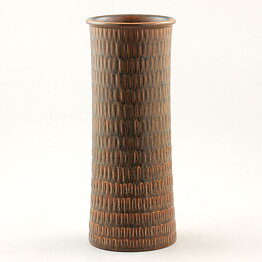
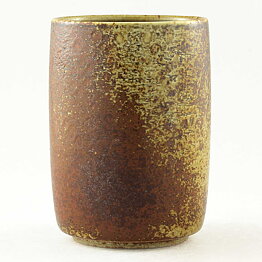
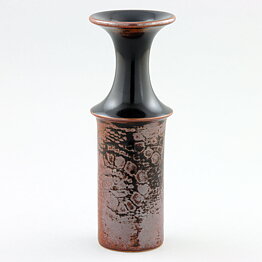
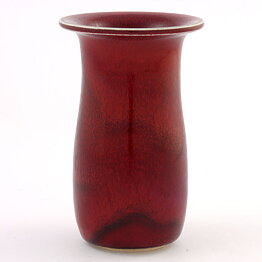
Stig Lindberg’s Unique Stoneware – An Overview
Stig Lindberg's unique objects come from a more than 40-year long artistry (1937–1982) at the Gustavsberg's Porcelain Factory. Most of the vases, bowls, and figurines were made of stoneware – a material he was interested in during his studies at the art school "Konstfack" in Stockholm.
| "To finish and personally sign my unique works of art gives me the highest of satisfaction." |
The unique pieces were all signed with "Stig L" underneath. However, the signature changed slightly over the years, which means that each object can be dated based on the style of the signature. A small number of them also have an incised "eye", which marks that the piece was of extra high quality.
It is worth mentioning that the unique objects were the result of teamwork. Skilled turners and glaze masters such as Sven Wejsfelt (1953–1970) and Dan Grip (1961–1982) supported Stig's unique production.
Unique Year Signatures

1937–1942

1942–1955

1956–1957

1958–1959

1960

1961

1962

1963

1964

1965

1966

1967

1968

1969

1970

1971

1972

1973

1974

1975

1976

1977

1978

1979

1980

1981

1982

Eye symbol
The 1940s – Surrealistic Debutant
At the age of 21, Stig Lindberg was employed as an assistant at Gustavsberg. He put his best foot forward and was eventually rewarded with more creative tasks. In 1941, Stig had his first exhibition at BJ (Gustavsberg's store in Stockholm) together with his colleagues Berndt Friberg and Calle Blomqvist. Art critics were curious about and appreciative of his work.

Stig Lindberg at the oven (1940s)
-22-cm.jpg)
Figurine "Llama" (1940s), 22 cm / 8.7 in
During the 1940s, figurines and sculptures were at the center of Stig's unique production. He freely incorporated motifs from all sorts of fairy tales and ancient myths. The objects gave a dreamlike and surreal expression.
The unique pieces during the period were often made of stoneware mixed with chamotte (fine-crushed burnt clay). The chamotte stoneware gave the unglazed parts a light brown color and a rustic look.
-31-cm.jpg)
Figurine "Girl with braids" (1940s), 31 cm / 12.2 in
-19-cm.jpg)
Figurine "Narcissus" (1940s), 19 cm / 7.5 in
In 1942, Gustavsberg's artistic leader Wilhelm Kåge started the G-Studio, which became a creative haven for the company's artists. Since then, Stig Lindberg’s all unique pieces were also marked with the so-called "Studio hand".
His unique stoneware got its significant breakthrough in 1945 at an exhibition at the NK department store in Stockholm. Stig exhibited his work together with colleagues Berndt Friberg and Wilhelm Kåge. They were humorously described as the "three wise men" in the press.
The 1950s – Stylistic Star
Stig stepped into the 1950s as the newly appointed artistic leader of Gustavsberg. During the decade, his unique stoneware was exhibited at the Triennale of Milan (1951, 1954, and 1957), H55 in Helsingborg (1955), and Georg Jensen in New York (1957).
Among the unique pieces, the tall vases with slender streamlined shapes distinguished themselves. They were often decorated with glazes in mild colors and radiated an aura of perfection.
| "The fifties were our harvest season. The only decade we were the best in the world." |
-38-cm.jpg)
High slender vase (1950s), 38 cm / 15.0 in
.jpg)
Advertisement for Stig Lindberg's unique stoneware (1950s)
The 1950s appreciation of geometric shapes and patterns could also be seen in Stig’s unique stoneware. This is most obvious in the vases with spherical bodies on a conical base, which are extremely popular among contemporary collectors. The style can also be seen in the ”Gnurgla” vases from 1954 with oval organic shapes.
-24-cm.jpg)
Vase with a spherical body and conical base (1950s), 24 cm / 9.4 in
-17-cm.jpg)
Gnurgla vase with organic shape (1950s), 17 cm / 6.7 in
The 1960s – Powerful Master
Stig Lindberg began the 1960s as a celebrity in the international design world. During the period, his unique stoneware was exhibited, among other places, at the large Swedish Form exhibition (1962).
A distinctive feature of the style were the vases with varying shapes and a segmented appearance. Concave, convex, and spherical sections were thrown separately and later joined to one piece.
-.jpg)
Stig Lindberg and Sven Wejsfelt (around 1960)
-13-cm.jpg)
Segmented vase with pressed pattern and turquoise glaze (1960s), 13 cm / 5.1 in
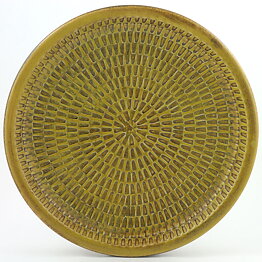
The unique object’s surfaces were carved or stamped with basket weave patterns. During the first years of the period, a matte turquoise glaze was often used. Later pieces were generally decorated with dark and earthy colors.
| "I have left my old style and become more rustic, powerful, and temperamental." |
-3%E2%80%936-cm.jpg)
Miniatures with typical shapes and glazes (1960s), 3–6 cm / 1.2–2.4 in
-23-cm.jpg)
Vase with penetrating figure (1960s), 23 cm / 9.1 in
Eventually, figures also appeared in the unique vases and bowls. These figures could penetrate the vessel walls with "Lindbergesque” humor. During the decade, Stig also made more unique miniatures, reasonably due to Gunnar Nylund's and Berndt Friberg's successes in this field.
The 1970s – Rustic Nestor
In the 1970s, Stig’s health deteriorated, and there were economic difficulties for Gustavsberg. During this period, his unique stoneware was exhibited at NK (1971) and in Höganäs (1973). The objects were given more folksy shapes and even more rustic expressions.
-30-cm.jpg)
Vase with tenmoku glaze and pressed textile pattern (1970s), 30 cm / 11.8 in
.jpg)
Stig Lindberg in the Gustavsbergs studio (1970s)
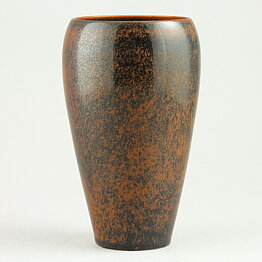
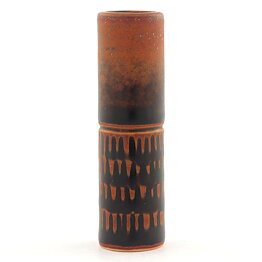
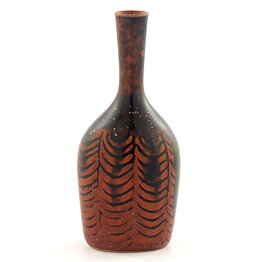
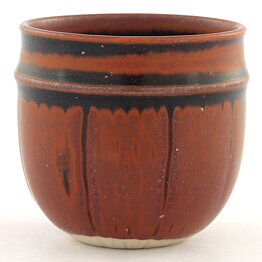
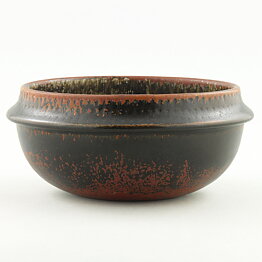
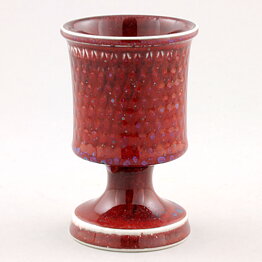
The unique pieces’ surfaces were patterned with textiles which gave snakeskin-like decorations. The glazes often had black-brown (tenmoku), ox-blood, or rust-yellow tones. During the decade, imaginative decanters appeared with steady human shapes and colorful glazes.
-18-cm.jpg)
Bottle-shaped vase with ox-blood glaze (1970s), 18 cm / 7.1 in
-20-cm.jpg)
Decanter with human shape in brown and yellow tones (1972), 20 cm / 7.9 in