
Hjördis Oldfors – A Biography
The early years
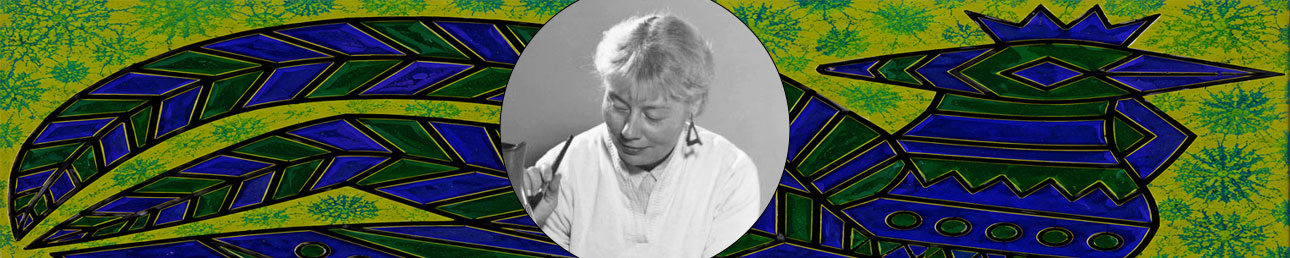
Hjordis Oldfors (1920-2014) was born in the western Sweden city of Gothenburg. Hjordis spent the first few years of her working life with as a banker. It was only when she was nearing 30 that she enrolled in the School of Design and Crafts in Gothenburg. When she completed her studies, she was given an apprenticeship painting patterns in the studio at Upsala-Ekeby. After her apprenticeship, she opened her own workshop, ”Brand Form” (Burned Form), in Gothenburg.

Prominent Upsala-Ekeby artists from left to right: Ingrid Atterberg, Taisto Kaasinen, Hjordis Oldfors, Mari Simmulson, Viking Göransson, and Sven Erik Skawonius.
Arrival at Upsala-Ekeby
When Upsala-Ekeby artist Anna-Lisa Thomson tragically passed away in 1952, the company needed a new designer, and Hjordis Oldfors returned. That marked the beginning of what she called her “eight good years.” Hjordis quickly rose to stardom, and her design was hailed by critics and the public alike. Alongside Ingrid Atterberg and Mari Simmulson, she completed a trio of strong female designers who would set the tone for Upsala-Ekeby in the fifties.

Left image, Hjordis adorning Palma vases in 1958. Right image, vases and bowl from the Trio series in 1958.
Black and White as Penguins
In the early 1950s, Hjordis was designing the black and white series, "Pingvin" (Penguin). The rumor is that her apartment’s black and white kitchen floor served as inspiration for the décor . The era-typical series consists of vases, dishware, bowls, and a kettle. The launch was quite successful: This penguin sure could fly!

Left image, Pingvin objects from 1954. Right image, Hjordis in her kitchen.
Queen of geometrical décor
Most of Hjordis’s series express her fondness for graphic patterns and décor, often in combination with softly-shaped pottery. Patterns and décor not only had an aesthetic purpose, but also filled a practical function. They effectively concealed joints in the vases created during the molding process.

Left image, Hjordis adorning a vase. Right image, Kokos bowl from 1954.
A taste for coconut
In the mid-1950s, Hjordis was hard at work designing the “Kokos" (Coconut) series. It consists of ten vases and bowls in earthenware with round forms. A yellow-glazed interior contrasts against the unglazed exterior with a carved, glazed edge. The Coconut series is now very sought after among pottery collectors.

Left image, painting with aquatic life motif. Right image, Hjordis during her golden years.
Short career, great success
According to the sales team at Upsala-Ekeby, Hjordis Oldforsʼs series were the easiest to sell throughout the fifties. This accolade says a lot considering the decade was considered the factory’s heyday. After her time in Uppsala, she returned to Gothenburg, dedicating herself to ceramics, textile art, painting, and teaching. With today’s interest in mid-century Nordic design, her work is experiencing a new golden-era on the second-hand market
