

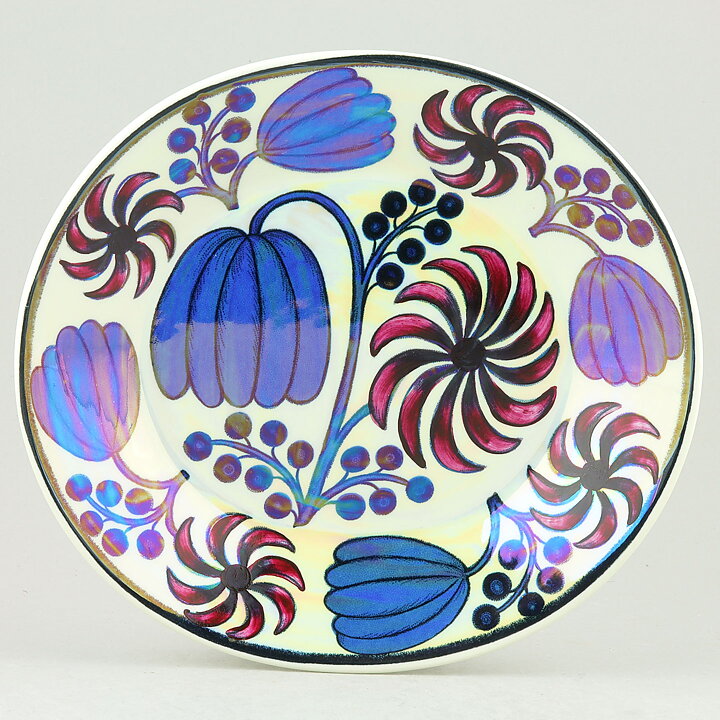

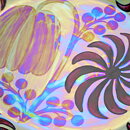
Birger Kaipiainen (Arabia 1970s) Brilliant Flower Wall Plate 21 cm
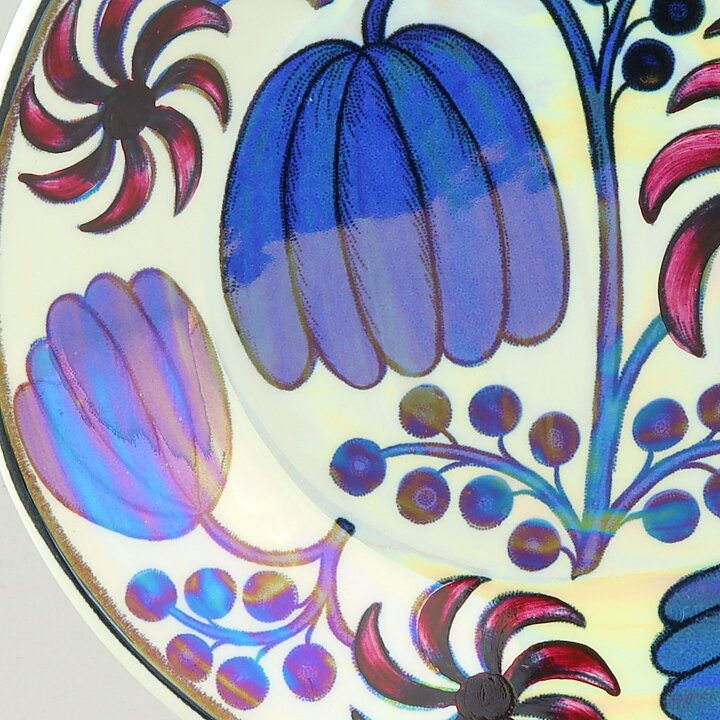
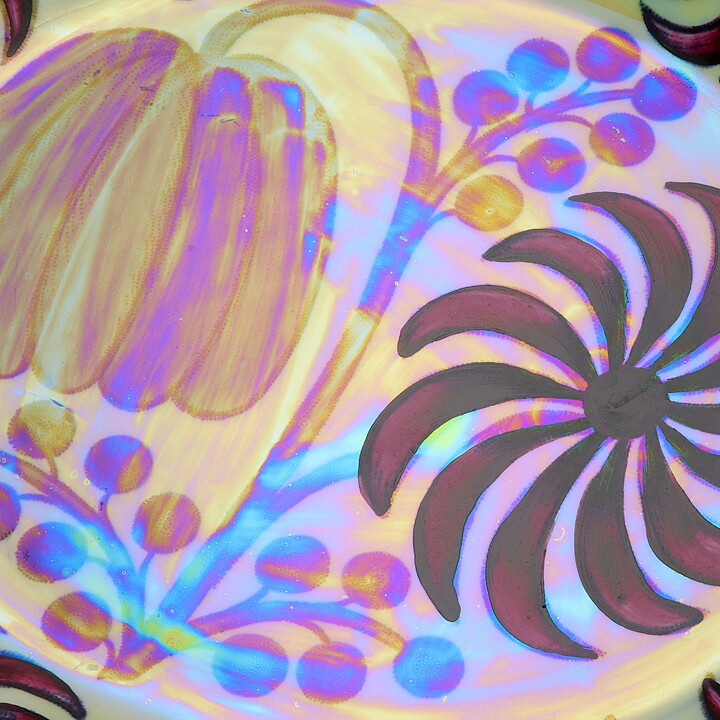
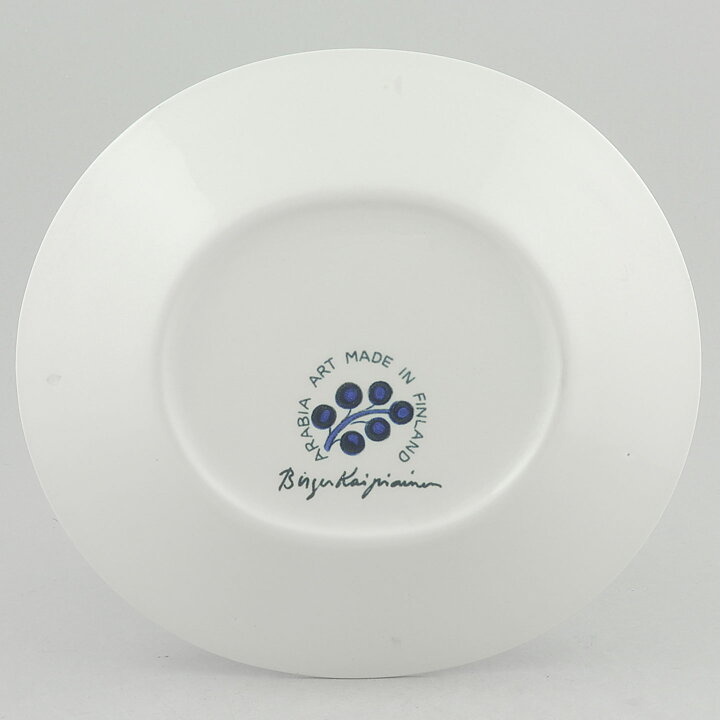
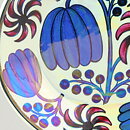
Birger Kaipiainen's wall plate with mother-of-pearl luster and a blue/red flower motif. It was crafted in the 1970s at the Arabia company. Heartwarming art piece from Finland!
Artist
Birger Kaipiainen
Year
1970s
Maker
Arabia, original production
Material
Porcelain
Condition
Very good vintage condition without any chips or cracks
Size
Length: 21 cm / 8.3 in
Width: 20 cm / 7.9 in
Marked
Arabia art, Made in Finland, Birger Kaipiainen
Options
Variants that match your options:
Price
Not available
Price
$303
Description
Article no.: 60646
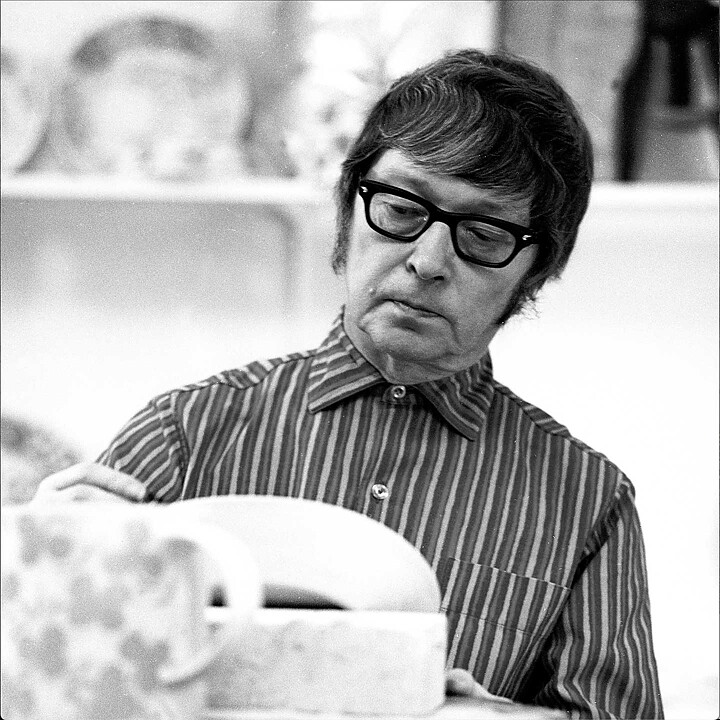
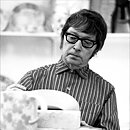
Birger Kaipiainen (born 1915 in Pori, died 1988) studied ceramics at the Central School of Arts and Crafts from 1933 until 1937 and on graduation began working in Arabia’s Art Department. His earliest works exuded enthusiasm for the culture of the Middle Ages and the Early Renaissance, especially theatre and visual art. He painted by hand the profiles of muses and female figures on chamotte plaques. The colors were fired at a low temperature to preserve the variety and nuances of the range of colors.
Kaipiainen also executed several decorations with fairy tale and theatrical motifs in sgraffito, especially for fashionable objects of the 1940s, such as the tops of tea tables and wall plaques. In 1949, he spent six month on an artists’ exchange program in Italy, where he was inspired by Gothic art, Byzantine mosaics, Etruscan art, and contemporary Italian ceramics. He made figures in a frontal pose with elongated limbs, stereotypical expressions, and richly decorative surfaces.
In 1953, Kaipiainen carried out his first experiments decorating dishes with combinations of ceramics and wire; the form and construction of his ’’bead birds” of the 1960s employed this technique. At Arabia, Kaipiainen made one-off pieces, except for the BK dinner service, which he designed in 1969. The BK pieces were based on an oval form; the best-known decoration in the service is Paratiisi (Paradise), which depicted luxuriant and succulent crops in a garden. In its white version, the service is known as Eeva (Eve) and in yellow
as Aatami (Adam). The second-quality version was decorated with the Apila (Clover) pattern.
Upon returning to Arabia in 1958 after a four-year exchange period with the Rörstrand factory in Sweden, Kaipiainen was provided with an assistant, Terho Reijonen. As a result of this collaboration, Kaipiainen’s output expanded; Reijonen and other employees of the factory made beads and other three-dimensional items in series. The dishes were cast and the various stages of the work were conducted simultaneously on a few half-finished pieces.
In his later works, Kaipiainen designed the colors to withstand glaze firing, in which an object would often require up to four firings at different temperatures.Various iridizing glazes, for example, would bring forth the brilliance of fruits and flowers and their baroque abundance.
Source: "Arabia - Ceramics, Art, Industry" by Marianne Aav et al. (2009)