
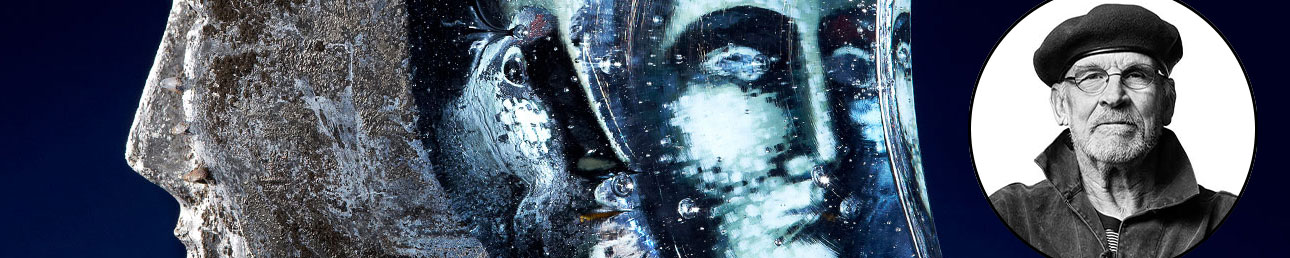
Bertil Vallien – Glass Heads
| "These heads are blessed or cursed, depending on how you choose to see them." |

Bertil Vallien's Heads - An Overview
The First Glass Heads
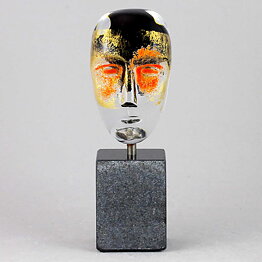
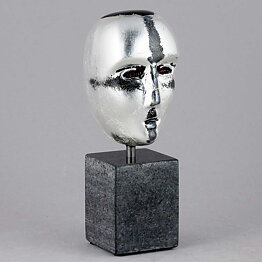
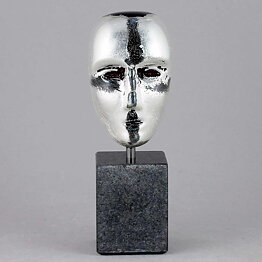
In 1994, Bertil Vallien started working with sand-casted glass heads. In the beginning, they were mounted on narrow plinths of black diabase or sandstone. The plinths were so high that the heads could meet the viewer’s gaze at the same height. The works of art looked like narrow bodies carrying the egg-shaped heads.
| "Capturing the expression, the light, and coaxing the secrets from the glass at the right moment is the challenge." |
The glass heads had been sighted in Bertil's earlier works but were then usually encapsulated in the sculpture. Now they have come out from inside the glass to stand by themselves. The heads describe various emotional states, ranging from calm and rest to angst and distraught. They often convey a sense of timelessness and ghostly spirituality.

Bertil Vallien behind a blue glass head

Blue glass head on pillar of stone
Karolina Olsson and the Blue Men
Bertil Vallien gained inspiration for the glass heads from a newspaper article about Karolina Olsson's strange fate. According to the newspaper, the 14-year-old Karolina was out on the ice outside Öland in 1876. She slipped and hit her head so hard that she lost consciousness. Karolina is said to have remained unconscious for 32 years. When she finally woke up in 1908, she told tales about great long-lasting darkness and the presence of blue men.
| "The story must have many depths that are not known." |
The story of Karolina gave Bertil the impulse to an exhibition of blue heads in Borgholm's castle ruin, near the place where the girl had fallen on the ice. The weathering ruin contrasted with the spiritual expressions of the heads. The exhibition in Borgholm was followed by successful international exhibitions in, for example, Seattle, Sydney, and Venice.
VIDEO: Bertil Vallien about the story of Karolina Olsson. (English subtitles available)
The Art of Molding Glass Heads in Sand
Bertil Vallien developed the technique of glass casting in sand molds during the 1970s. This method has since become a well-known signature for him. A successful sand-casting of a glass head consists of several steps:
1. Bertil plans the shape, size, color scheme and content of the glass head in sketches. Information about how the head will later be manufactured in the glass forge is often attached.
| "The sketch is the universal language. Wherever I have been and worked in the world, sketching has been a way of communication when words were not enough." |
2. A wooden model of the head is made by hand. It will be used to create the shape that determines the size of the sculpture.

1. Bertil Vallien sketching heads

2. Wood models for making the mold
3. Red molding sand of suitable humidity is placed in a metal box. The wooden model is pressed down and creates an impression. The casting sand is packed hard to be able to withstand the glass mass.
4. Bertil creates imprints in the sand mold's surface through stamps, pens and other tools. These will cause irregularities in the exterior of the glass head.

3. Bertil Vallien shapes the casting sand with wooden models

4. Bertil scrapes the mold to affect the exterior of the glass head
5. Melted full crystal glass with a temperature of 1200 degrees Celsius is poured into the sand mold. For some glass heads, objects are now placed in the glowing glass mass. A gas burner is finally used to smooth out the surface. The hot mold is then fed into a cooling oven to slowly cool.
6. When the glass head leaves the mold, the casting sand is brushed off. Some heads can then be ground or decorated by hand.

Glass mass in a mold is smoothed out by gas burners

Bertil Vallien is touching-up a sand-casted head
The Two-Headed Janus Sculptures
In the late 1990s, Bertil Vallien began to introduce a smaller head in the casting of a larger glass head. The faces were usually turned away from each other, which gave associations to the Roman god Janus. Often the back of the larger head was ground in the shape of an ax. The grinding broke the light and multiplied the encapsulated face in an optical effect.
| "By working with transparent glass heads, I could not only make the expression on the faces but also add a story inside." |

Bertil Vallien with a blowtorch

Two-headed glass sculpture with an optical effect
Resting Heads
Bertil Vallien created the 1998 series "Resting heads" with egg-shaped sculptures resting on plinths. Inside the matte surface, the contours of a frozen head could be seen. The works of art convey the feeling of an encapsulated seed that was about to be born again. These sculptures were made in two parts which were then glued and sanded by hand.
| "When the glass has solidified, and you see the defects, blisters, and bubbles, it looks like a mini-universe. A frozen piece of human life." |

Glass sculpture from the series "Resting Head"

Bertil Vallien with a "Resting Head" sculpture
A Selection of Bertil Vallien's Glass Heads
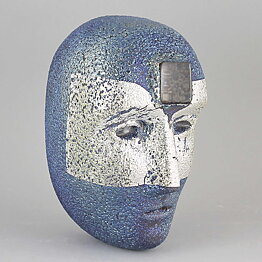
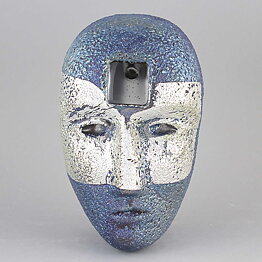
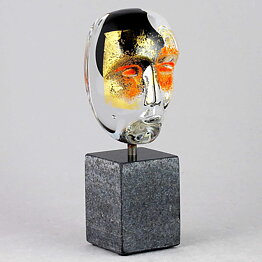
Bertil has sand-casted hundreds of heads with different shapes, color schemes, and artistic content. His glass sculptures are represented at the most well-known art museums in the world such as the Metropolitan Museum in New York and Victoria & Albert in London. Here is a selection of his heads!

"Look in orange"

"Resting head"

”Indian head”

"Resting head"

"Tor"

Unique head sculpture

Janus sculpture in the "Brains" series

"Yes"

Unique head

"Screw head"
References
Video:
The video clip comes from Peter Kruse's documentary "Glasmästaren" which was shown on SVT 2015. It can be seen in its entirety here.
Visit the page with all our objects by Bertil Vallien.