






Francesca Mascitti-Lindh (Arabia 1960s) Rustic Spice Jar "Paprikaa" (Bell Pepper) 6 cm (1)
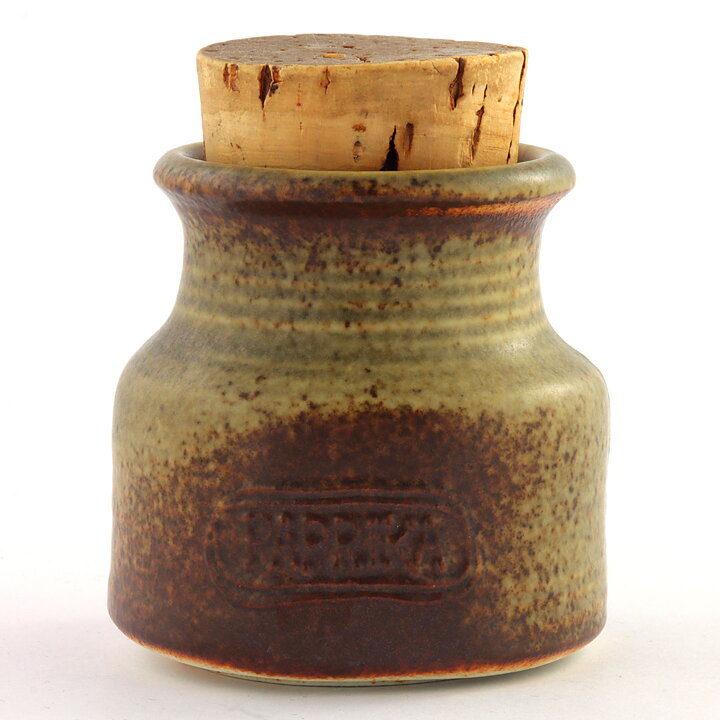
Francesca Mascitti-Lindh's spice jar "Paprikaa" (Bell Pepper) with a sturdy form and rustic expression. It was crafted in the 1960s at the Arabia studio. An era-typical kitchenware piece from the Finnish mid-century!
Artist
Francesca Mascitti-Lindh
Name
Bell Pepper
Paprikaa (Finnish)
Paprika (Swedish)
Year
1960s
Maker
Arabia, original production
Material
Earthenware
Condition
Very good vintage condition without any chips or cracks
Size
Height (pottery): 6 cm / 2.4 in
Width: 6 cm / 2.4 in
Depth: 5 cm / 2.0 in
Marked
FML (Francesca Mascitti-Lindh), Arabia
Options
Variants that match your options:
Price
Not available
Price
$19
Description
Article no.: 59980
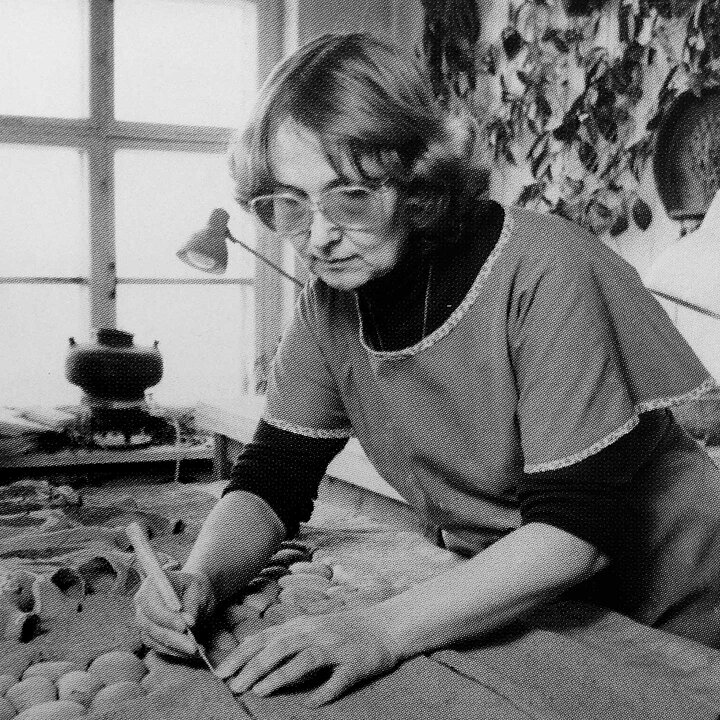
Francesca Mascitti-Lindh (born 1931, in Anversa degli Abruzzi, Italy) studied in Rome from 1946 to 1948 and at the Institute of Industrial Art in Helsinki from 1949 to 1952. She specialized in ceramics and then shares a studio in Helsinki with her husband, Richard Lindh. Mascitti-Lindh worked in Arabia’s Art Department from 1955 to 1989.
She is known for her one-off ceramics, rustic vases, and pots, often with two spouts, like traditional water pitchers of the Mediterranean region. Mascitti-Lindh wheel-turned her pieces in the 1950s and 1960s and carried out numerous experiments with form by cutting wheel-turned pieces that were often of closed configuration.
Her work evolved in a more abundant direction with emphasis on the structure of the ceramic material. She would roll out fragile plant motifs on clay plaques, boldly combine materials, and emphasize foliate forms with delicate pastel- hued and lustre glazes. White, blue, and brown ceramic pastes of different hues create winding structural landscapes on the three-dimensional surfaces of the pots and reliefs.
Source: "Arabia - Ceramics, Art, Industry" by Marianne Aav et al. (2009)